
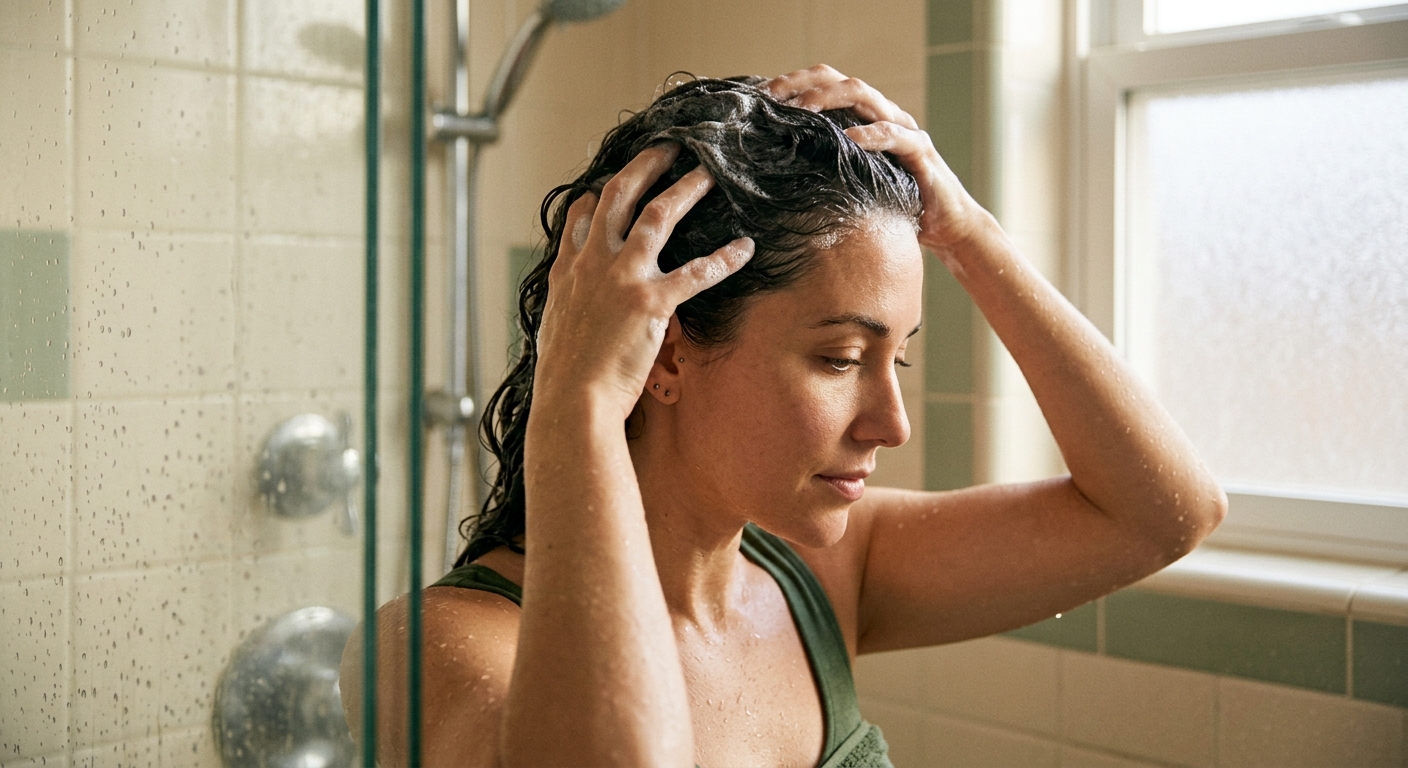
If you’ve been dealing with flaky, itchy patches on your scalp, you’ve probably already tried a psoriasis shampoo. Maybe it helped a little. Maybe it barely made a dent. Either way, if you’re still fighting buildup and itching, you’re not doing anything wrong — a shampoo alone often just isn’t enough to finish the job.
What’s Actually Happening on Your Scalp
Scalp psoriasis isn’t dandruff, and it’s not caused by poor hygiene. It’s an autoimmune condition. Your immune system tells your skin to grow new cells way faster than normal. Those cells pile up before your body can shed the old ones, which is why the scale builds up so fast.
It’s also a lot more common than people think. The National Psoriasis Foundation says more than half of people with psoriasis — somewhere between 52% and 80% — deal with it on their scalp at some point. So if this is where yours shows up, you’re in good company.
Is It Psoriasis, Dandruff, or Something Else?
This is where a lot of people get stuck, because they all cause flaking. Here’s a simple way to tell them apart, according to Mayo Clinic:
Scalp psoriasis scales are usually thicker and drier, with a silvery or powdery look. They often spread past the hairline onto your forehead or neck. Regular dandruff (also called seborrheic dermatitis) tends to look more yellow and greasy, and it usually stays right on the scalp.
Psoriasis also rarely shows up in just one spot. If you’re also noticing patches on your elbows, knees, or lower back, or changes in your nails, that’s a good sign it’s psoriasis. Mayo Clinic also notes scalp psoriasis tends to be more stubborn than regular dandruff — which is exactly why a basic dandruff shampoo often doesn’t cut it.
What Sets Off a Flare-Up
Flares don’t just happen randomly. The most common triggers, according to dermatologists and the National Psoriasis Foundation, are stress, cold or dry weather, scratching or other trauma to the skin, certain medications, getting sick, and smoking or drinking. Stress is a tricky one, because it works both ways: the itching and flaking stress you out, and that stress can trigger the next flare. Once you know your own triggers, you can get ahead of a flare instead of just reacting to it.
Why a Psoriasis Shampoo Alone Often Isn’t Enough
Most psoriasis shampoos tell you to leave them on for two to three minutes before rinsing. Almost nobody actually does that in the shower. And once the itching eases up a bit, it’s easy to slide back into your regular shampoo, which undoes the progress.
There’s also a simple, practical problem: if the psoriasis on your scalp has built up into thick patches, it’s hard for any treatment to actually reach the skin underneath all that scale. That’s the whole point of a scale softener (usually made with salicylic acid) — it’s not a treatment by itself, it just clears the way so a psoriasis shampoo or cream can actually work.
A More Complete Scalp Psoriasis Treatment Routine
Instead of relying on one product, it helps to think of it as three simple steps:
First, a psoriasis scalp oil or scale softener, left on (often overnight), to gently loosen thick buildup so you’re not tempted to scratch or scrub it off. Scratching and scrubbing can actually make things worse and even contribute to hair loss.
Second, a psoriasis shampoo, left on for the full time the label recommends, to calm the inflammation and slow down that overactive cell turnover.
Third, a psoriasis cream for problem areas after your scalp is clean, to keep the skin calm and moisturized between washes.
Most people following a routine like this start seeing real improvement within about a month, though everyone’s skin is a little different.
What to Look for in a Psoriasis Shampoo or Cream
Not every psoriasis shampoo on the shelf works the same way. The ingredients dermatologists point to most are salicylic acid (a gentle scale softener and usually a good place to start), zinc pyrithione (helpful for yeast-related flaking), and coal tar (effective, but it has a strong smell and isn’t used as much anymore). All three are regulated over-the-counter ingredients, so you can check for them right on the label of any psoriasis shampoo or psoriasis cream you’re considering.
When It’s Time to See a Dermatologist
Over-the-counter care handles a lot of scalp psoriasis, but not all of it. If you’re dealing with real hair loss, bleeding, or scale that just won’t budge no matter how consistent you are, it’s time to see a dermatologist instead of trying yet another drugstore shampoo. They may prescribe a stronger topical steroid cream (the most commonly prescribed psoriasis treatment, and one that often works within days) or a prescription-strength psoriasis shampoo, and for tougher cases, light therapy or other treatments. It’s also worth taking seriously because people with psoriasis have a higher risk of eventually developing psoriatic arthritis — so getting it under control is about more than how your scalp looks.
Why I Built This Routine
I first started formulating these products for my mother, who dealt with psoriasis herself — that’s really where Dermasolve began. The Scalp Kit came later, and it grew directly out of what our customers kept telling us: that a psoriasis shampoo alone wasn’t solving the problem, and that they needed a full routine, not just one bottle. That feedback is what shaped the kit into a psoriasis shampoo, scalp oil, and cream designed to work together. I want to be upfront that this isn’t a neutral pick — it’s a routine I built based on real customer experience, and I believe in it.
If you want to try this same three-step approach, you can find the Scalp Kit here on Amazon.
The Bottom Line
A psoriasis shampoo is a reasonable start, but it’s usually not the whole answer. Scalp psoriasis responds best to a routine that softens buildup, treats inflammation with enough contact time, and calms your skin in between washes with a psoriasis cream — with a dermatologist in the loop if over-the-counter care isn’t working after a few weeks of really trying. Small, consistent changes tend to matter more than any single product.
Mike Marenick is the founder of HealFast Skincare and holds the patent for his invention, Ovasome Technology, used in skincare formulations. He began developing skincare products after watching his mother manage psoriasis for decades, and has spent over twenty years formulating treatments for chronic skin conditions. His work has been featured on Home Shopping Network, in two national infomercials, and in more than 300 publications including Vogue, Newsweek, and Allure. He is not a medical doctor — always consult a dermatologist for diagnosis and treatment of skin conditions.
As an Amazon Associate, Itch and Flare earns from qualifying purchases.