
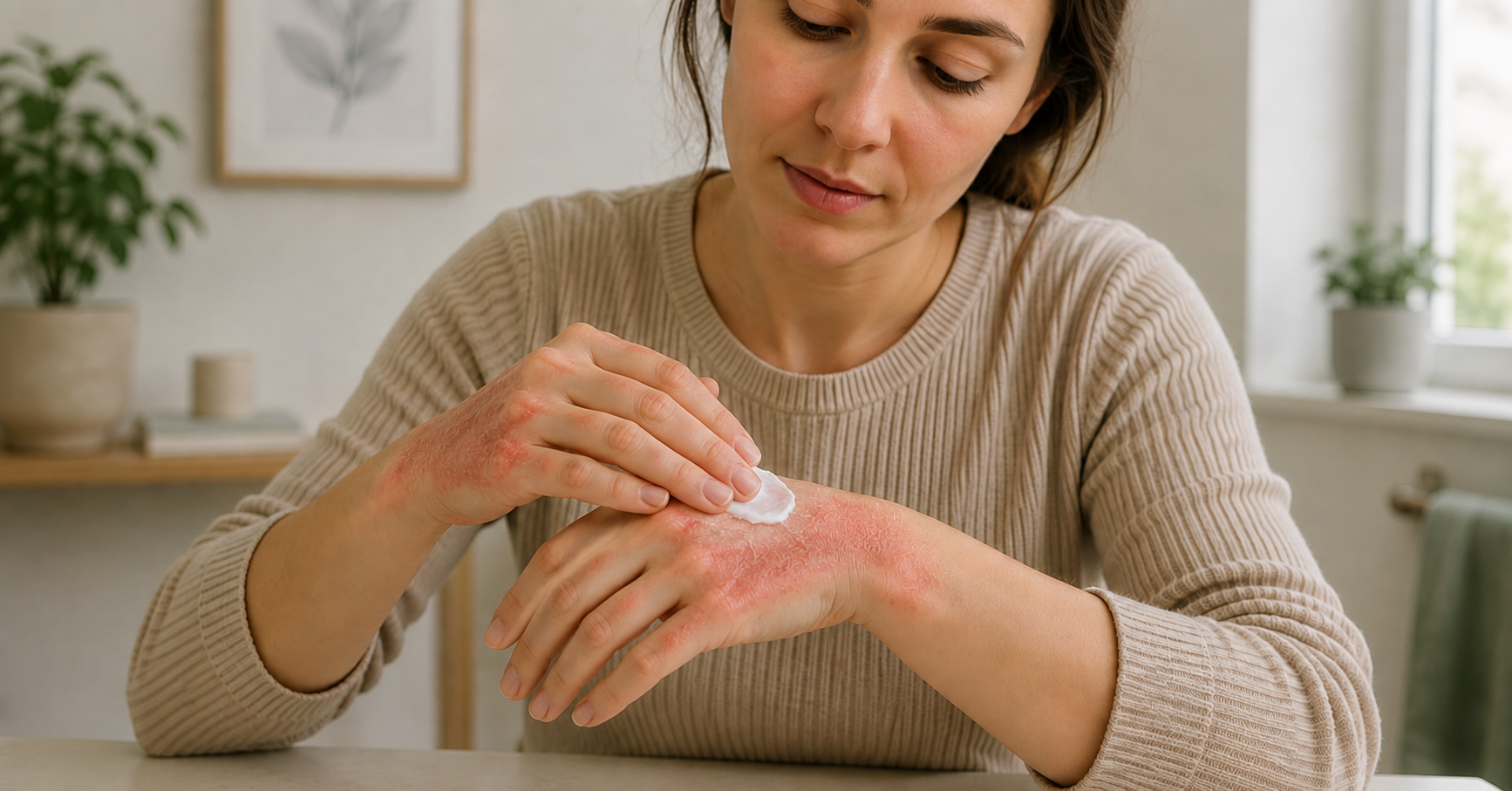
“Eczema” isn’t one condition — it’s an umbrella term for several different types of eczema, each with its own causes and best way to manage it. Getting the type right matters, because what calms one kind of eczema down can do very little for another. Here are the three most common types, what actually causes each one, and how to tell them apart.
Atopic Dermatitis: The One Most People Mean When They Say “Eczema”
Atopic dermatitis is the most common form, and it’s the one most people picture when they hear the word “eczema.” It usually shows up first in childhood, often on the cheeks, elbows, or knees, though it can appear at any age and on almost any part of the body.
The root cause is a weak skin barrier — the outermost layer of skin that normally keeps moisture in and irritants out. In atopic dermatitis, that barrier doesn’t hold together as well as it should, often because of a genetic difference in a protein called filaggrin that helps build it. (This is the same barrier science behind ceramide loss covered in the previous article — atopic dermatitis is a good example of what happens when that barrier structure is compromised from the start.) With a weaker barrier, moisture escapes more easily and irritants, allergens, and bacteria get in more easily, which is what triggers the itching and inflammation.
Atopic dermatitis also tends to travel with other conditions — allergies, asthma, and hay fever are all more common in people who have it, sometimes called the “atopic triad.” It’s typically chronic, meaning it flares and calms down over months or years rather than clearing up permanently.
Common signs: dry, intensely itchy skin; often in the creases of elbows and knees, or on the face and hands; skin that can look leathery or thickened in areas that are scratched repeatedly over time. A fragrance-free, barrier-repairing moisturizer designed specifically for eczema-prone skin — like Mustela’s Stelatopia Intense Eczema Relief Cream, which is recommended by the National Eczema Association — can help calm and hydrate skin affected by atopic dermatitis.
Contact Dermatitis: When Something Touches Your Skin and Reacts
Contact dermatitis is different in a fundamental way — it’s not something a person is generally predisposed to the way atopic dermatitis often is. It happens because something specific touched the skin and caused a reaction. There are two versions of it, and they work differently:
Irritant contact dermatitis happens when a substance directly damages the skin — think harsh soap, cleaning products, or repeated hand-washing. It doesn’t require an allergy; the substance is just abrasive or drying enough to injure the skin barrier on contact. This is the more common of the two types.
Allergic contact dermatitis happens when the immune system reacts specifically to something it’s decided is a threat — common culprits include nickel (in jewelry or belt buckles), fragrance, certain preservatives in skincare products, or poison ivy. Unlike the irritant version, this usually requires prior exposure — the immune system has to “learn” to react to that specific substance first, which is why someone can use a product for years and then suddenly develop a reaction to it.
Common signs: redness and irritation typically confined to wherever the skin made contact with the trigger substance — often a clear shape or pattern (a ring from a ring, a line from a watchband) that can be a useful clue to what caused it. Since contact dermatitis is triggered by direct exposure to an irritant or allergen, gentle, soothing products matter — something like Eczema Honey’s Original Skin-Soothing Cream, a fragrance-free option formulated to calm reactive, irritated skin.
Dyshidrotic Eczema: Small, Itchy Blisters on Hands and Feet
Dyshidrotic eczema (sometimes called pompholyx) looks and behaves differently from the other two. It shows up as small, deep-set, intensely itchy blisters, almost always on the palms, the sides of the fingers, or the soles of the feet.
The exact cause isn’t fully understood, but it’s associated with stress, seasonal allergies, sweaty or damp hands, and — notably — with the same weakened-barrier and atopic tendencies that show up in atopic dermatitis. Some people who get dyshidrotic eczema also have atopic dermatitis elsewhere on their body, which suggests overlapping underlying causes rather than two completely unrelated conditions.
Common signs: clusters of small blisters specifically on the hands and feet (not typically anywhere else on the body); intense itching or a burning sensation, sometimes before the blisters are even visible; blisters that can be small and numerous rather than one large one. A fragrance-free moisturizing skin protectant — such as Theraplex Eczema Therapy, another National Eczema Association-approved option with colloidal oatmeal — can help support the skin barrier between flares.
Why Getting the Type Right Actually Matters
These three types can look similar at a glance — red, itchy, inflamed skin — but the right response is different for each. Contact dermatitis often improves significantly just by identifying and avoiding the trigger substance, which isn’t a meaningful factor in atopic dermatitis. Atopic dermatitis responds well to barrier-repair strategies (moisturizing routines built around ceramides and similar barrier-supporting ingredients) that don’t do much for a one-off irritant reaction. Dyshidrotic eczema’s blister pattern is distinct enough that it’s often what leads a dermatologist to check for it specifically, since the treatment approach for blistering skin differs from general dry, itchy patches.
If it’s not clear which type is involved, or if symptoms are severe, spreading, or not improving with basic care, that’s a good reason to see a dermatologist rather than guess — they can often tell the types apart on sight, and can run patch testing for suspected allergic contact dermatitis if needed.
Mike Marenick is the founder of HealFast Skincare and holds the patent for his invention, Ovasome Technology, used in skincare formulations. He began developing skincare products after watching his mother manage psoriasis for decades, and has spent over twenty years formulating treatments for chronic skin conditions. His work has been featured on Home Shopping Network, in two national infomercials, and in more than 300 publications including Vogue, Newsweek, and Allure. He is not a medical doctor — always consult a dermatologist for diagnosis and treatment of skin conditions.
As an Amazon Associate, Itch and Flare earns from qualifying purchases.