

If you’ve ever asked what causes eczema, here’s the short answer: it’s not really about your immune system at first. It’s about the physical structure of your skin.
Your skin’s outer layer is supposed to act like a wall. It keeps moisture in and keeps irritants out. In eczema, that wall has gaps in it. Everything else follows from there — the dryness, the itching, and eventually the immune reaction too.
Your Skin Is a Brick Wall. The Mortar Is Missing.
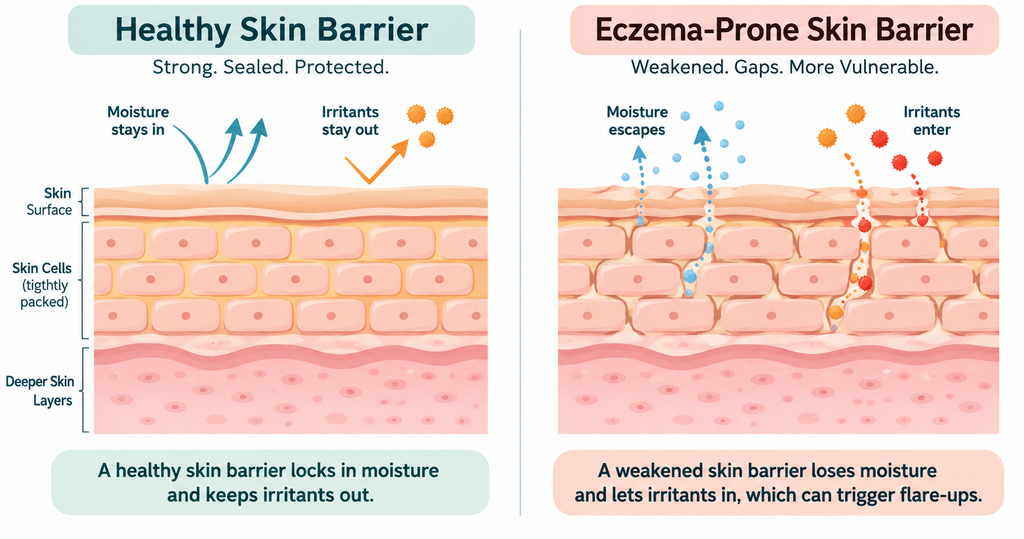
Think of your skin’s outer layer like a brick wall. The skin cells are the bricks. Holding them together is a layer of fats, mostly ceramides. Think of that as the mortar.
In healthy skin, the mortar is thick and tightly packed. It seals the wall. Moisture stays in. Irritants stay out.
In eczema-prone skin, the mortar is thinner. That leaves small gaps in the wall. Moisture escapes through those gaps, which is why eczema skin is so often dry. And things that shouldn’t get in — irritants, allergens, bacteria — slip through instead.
One Gene Makes a Big Difference
A big part of why some people’s skin wall is weaker comes down to one gene, called filaggrin.
Filaggrin helps hold skin cells tightly together and helps build that mortar layer. When this gene doesn’t work properly, your body makes less of it. The wall ends up thinner and leakier.
A few facts on this:
- About 1 in 10 people carry this gene variant.
- More than half of people with eczema carry it.
- People who carry it are more likely to have eczema that starts early and sticks around into adulthood, instead of a mild case that fades in childhood.
This gene isn’t the only piece. Other genes involved in making the skin’s fats also play a role. That’s part of why moisturizers with ceramides in them can genuinely help — they’re replacing something the skin isn’t making enough of on its own.
How a Leaky Wall Turns Into a Flare-Up
Once irritants and allergens slip through the gaps in your skin, your immune system reacts to them, the same way it would react to anything from outside your body. This reaction releases chemical signals that cause redness, swelling, and intense itching.
Here’s the frustrating part: those same chemical signals also make your skin produce even less of the mortar that holds it together. So the immune reaction doesn’t just respond to the leaky wall. It makes the wall leakier.
That’s the cycle at the center of eczema: a weak wall lets more irritants in, which triggers a bigger immune reaction, which weakens the wall even more.
This is also why some newer eczema medications work by blocking those specific immune signals directly. Doing so doesn’t just calm the itching — it can help skin start rebuilding its own barrier again.
Why Scratching Makes It Worse
The itch in eczema isn’t just uncomfortable. Scratching physically damages the wall even further. That lets in more irritants, which restarts the whole reaction. This is sometimes called the itch-scratch cycle, and it’s a big reason eczema can feel impossible to get ahead of once a flare starts.
Why Eczema Often Shows Up First
Researchers have noticed a pattern: eczema often shows up before other allergy-related conditions, not alongside them. Many kids with eczema go on to develop food allergies, asthma, or hay fever later on. Researchers call this the “atopic march.”
The leading theory ties back to the same leaky wall. When allergens can get through gaps in the skin early in life, the immune system may become sensitive to them in a way that shows up later as an allergy or asthma, not just as a skin problem. Not everyone with eczema follows this pattern. But it’s well documented, and it’s one more reason treating the skin barrier early matters, not just for comfort.
What Can Make It Worse
None of these cause eczema in someone who wasn’t already prone to it. But they can expose or worsen an already-weak wall:
- Over-washing or harsh soap. Frequent washing, especially with strong soap, strips away what little mortar is already there.
- Dry air and cold weather. Less moisture in the air pulls moisture out of your skin faster than it can replace it.
- Sweat and friction. Both irritate skin that’s already compromised.
- Rough fabrics, especially wool, which can physically irritate weak skin.
- Allergens like dust mites, pet dander, and certain foods, which can get through a weak wall more easily than they would in typical skin.
Why This Matters for How You Treat It
Since eczema starts with an actual gap in your skin’s wall, what you put on your skin matters just as much as what you avoid. That’s part of why a growing number of skincare products are turning to naturally sourced, food- and plant-based ingredients for their nutritional content, instead of relying purely on synthetic vitamins or lab-created proteins.
A few examples: acai berry, prized for its natural antioxidants, shows up in products aimed at protecting skin from environmental damage. Honey, valued for its natural humectant properties (meaning it draws and holds moisture in the skin) and its long history of soothing irritated skin, appears in everything from cleansers to masks. The idea behind all of these is the same: rather than isolating a single synthetic compound, use an ingredient nature already packed with a wide range of complementary nutrients.
Whole egg takes that idea about as far as it can go. Consider what’s inside an egg: it’s the only food source a developing chick has access to before it hatches — no outside nutrition added. And it works. A single egg contains complete proteins, essential fatty acids, cholesterol, vitamins, minerals, and lipids like ceramides, all in roughly the balance a living creature needs to grow an entire body from scratch. It’s about as complete a nutritional package as exists in nature.
A Common Concern: “Doesn’t Egg Make Eczema Worse?”
If you’ve read up on eczema before, you’ve probably heard this claim — and there’s some truth behind it, just not a direct one.
Egg doesn’t cause eczema, and egg doesn’t make eczema worse. Eggs would only be a problem for someone who has eczema and a known egg allergy. Since most people with eczema aren’t allergic to egg at all, the benefits of egg’s broad nutritional content and natural ceramides can actually benefit your skin.
As with any skincare product, you should always do a quick patch test before using it, especially if you have any known food or ingredient allergies.
HealFast’s Ovasome Technology (patented by our founder, Mike Marenick) applies that same completeness topically, delivering whole egg’s natural nutrient profile — ceramides included — directly to the skin’s barrier, rather than relying on a single isolated ingredient. It’s the technology behind Dermasolve’s Eczema Relief Cream, which pairs it with 2% colloidal oatmeal to calm and protect already-irritated skin.
That’s why dermatologists usually recommend treating eczema on two tracks: rebuilding the wall with the right moisturizer, and, for moderate to severe cases, calming the immune reaction directly with a prescribed treatment. Moisturizer alone often isn’t enough once the immune reaction is already active.
When to See a Dermatologist
- Your skin is spreading, oozing, or crusting (a possible sign of infection)
- Moisturizer alone isn’t helping after a few weeks of consistent use
- Itching is disrupting your sleep
- You’re not sure if what you’re seeing is eczema or something else
A proper diagnosis matters, since different skin conditions are treated differently even when they look similar at a glance.
Mike Marenick is the founder of HealFast Skincare and holds the patent for his invention, Ovasome Technology, used in skincare formulations. He began developing skincare products after watching his mother manage psoriasis for decades, and has spent over twenty years formulating treatments for chronic skin conditions. His work has been featured on Home Shopping Network, in two national infomercials, and in more than 300 publications including Vogue, Newsweek, and Allure. He is not a medical doctor — always consult a dermatologist for diagnosis and treatment of skin conditions.
As an Amazon Associate, Itch and Flare earns from qualifying purchases.