
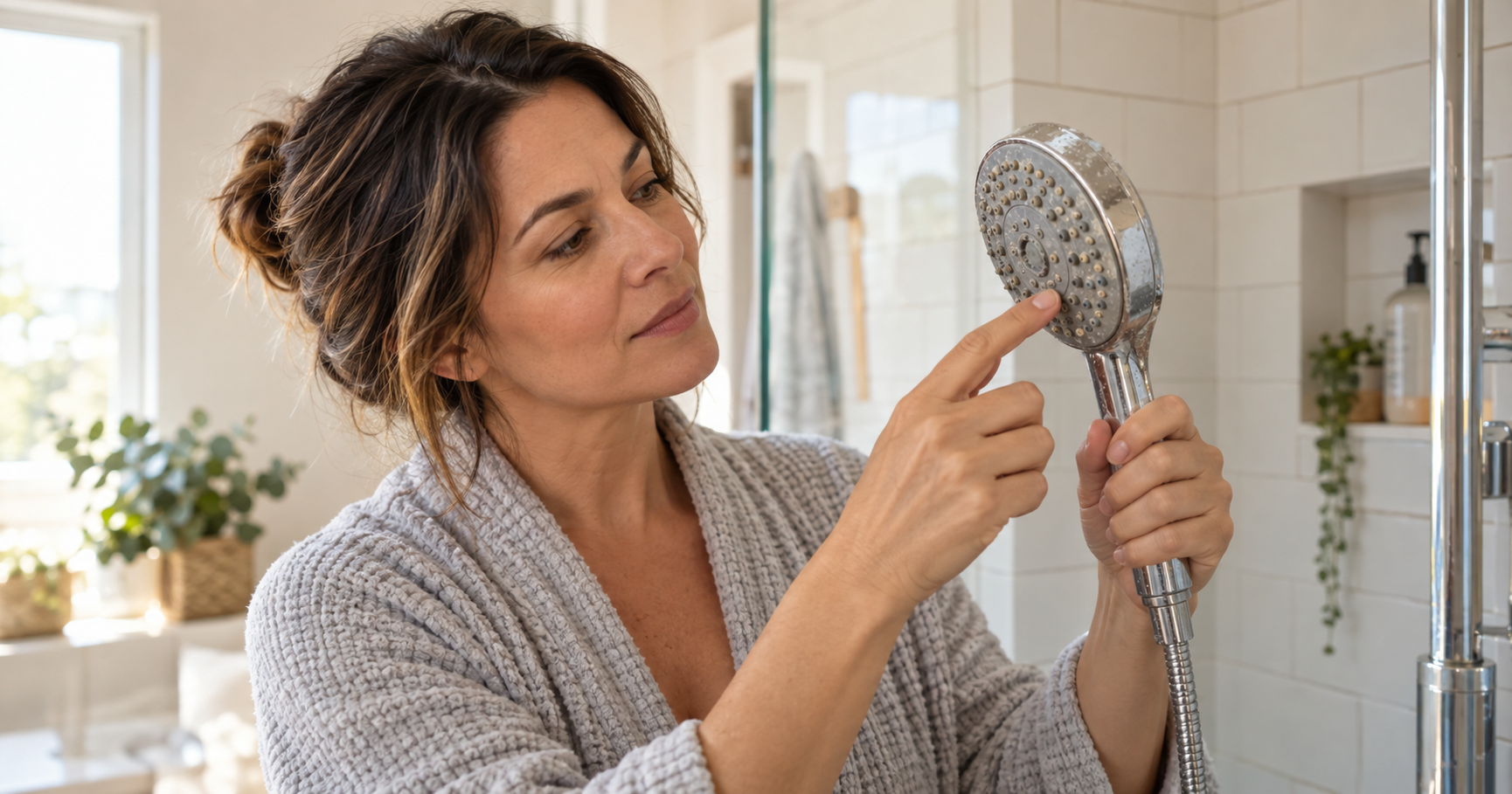
If your eczema treatments aren’t working as well as they should, hard water eczema treatment problems might be part of the reason, and it’s probably not your products that are the issue. It’s what’s happening to your skin before those products even get a fair shot.
What Actually Makes Water “Hard”
Hard water just means water with a higher amount of dissolved minerals in it, mainly calcium and magnesium. Once water crosses about 120 parts per million of these minerals, it’s considered hard, and depending on where you live, there’s a good chance your tap water falls into that range.
Two Ways Hard Water Works Against Your Skin
There are really two things going on here, and both matter.
First, calcium and magnesium can settle right onto your skin and mess with the natural lipid layer that keeps your barrier sealed up. Second, and this is the bigger deal, those same minerals react with soap and a lot of cleansers to form a residue often called soap scum. Instead of rinsing off cleanly, it clings to your skin.
Why This Specifically Gets in the Way of Your Treatment
Here’s the part that really matters if you’re already doing everything right. That leftover film can sit on top of your skin and block your moisturizer or medicated treatment from actually soaking in. You could be using a great product, consistently, and still seeing disappointing results, not because the product’s wrong, but because hard water residue is standing in its way.
There’s Also a pH Problem
One more thing worth knowing. Healthy skin sits at a naturally slightly acidic pH, somewhere around 4.5 to 5.5. Hard water tends to run alkaline, often above 8.5. That mismatch can wear down an already-struggling skin barrier even further, stacking on top of the mineral residue itself.
What the Research Actually Shows
Let’s be honest here instead of overselling it. Hard water’s effect on skin is a well-documented mechanism, and some research, including a notable study out of King’s College London, has linked hard water to higher eczema risk, especially in infants. That’s led some researchers to think early life might be a particularly important window for water quality.
But when it comes to treating eczema someone already has, the picture gets murkier. The biggest clinical trial testing water softeners as an actual treatment, called the SWET trial, didn’t find a statistically significant improvement in eczema severity from installing one. So reducing hard water exposure is worth trying as part of your overall approach, just don’t expect it to be a magic fix on its own, or a replacement for the rest of your treatment plan.
Your Options, Side by Side
| Whole-Home Water Softener | Shower Filter | Free Habits | |
|---|---|---|---|
| What it does | Removes calcium and magnesium through ion exchange | Reduces mineral buildup at the shower head | Limits damage without changing your water |
| Cost | Highest, plus installation | Affordable, renter-friendly | Free |
| Effort | Professional install usually needed | Easy to install yourself | Just a routine change |
| How complete | Most thorough fix | Noticeable, but not as complete | Helps, but doesn’t address the water itself |
A hard water shower filter is a solid middle-ground option if a whole-home softener isn’t in the cards right now, easy to install and a lot more affordable.
The Free Habits Still Matter
- Keep showers short and lukewarm instead of hot.
- Use a gentle, fragrance-free cleanser.
- Moisturize within about three minutes of getting out of the shower or bath, while your skin is still a little damp, to help lock moisture in before it evaporates. Dermasolve’s Eczema Cream is a good fit here, especially once you’ve cut down on mineral residue so it can actually absorb the way it’s meant to. We walk through the right order to layer a full routine here.
When to See a Dermatologist
- Your routine isn’t improving things despite consistent use
- You’re weighing a water softener or filter and want to know if it’s worth it for you
- You notice a filmy residue on your skin after washing and aren’t sure if hard water’s the cause
- Flares are severe or frequent no matter what you’ve already tried
Hard water is one piece of a bigger picture. It’s worth addressing, but it’s rarely the whole story on its own.
Mike Marenick is the founder of HealFast Skincare and holds the patent for his invention, Ovasome Technology, used in skincare formulations. He began developing skincare products after watching his mother manage psoriasis for decades, and has spent over twenty years formulating treatments for chronic skin conditions. His work has been featured on Home Shopping Network, in two national infomercials, and in more than 300 publications including Vogue, Newsweek, and Allure. He is not a medical doctor — always consult a dermatologist for diagnosis and treatment of skin conditions.
As an Amazon Associate, Itch and Flare earns from qualifying purchases.
Leave a Reply